
Introduction
In an era where digital privacy concerns dominate headlines and data breaches become increasingly common, the need for truly secure communication has never been more critical. This article explores the development and deployment of Someone, an ephemeral messaging platform designed to offer strict, time-bound message deletion and a privacy-first, no-account architecture.
Someone represents more than just another messaging application. It is a production-ready solution that demonstrates how thoughtful design, enterprise-grade security, and user-centric principles can converge to create a tool that genuinely protects privacy without sacrificing usability.
The Challenge: Traditional Communication Solutions Fall Short
In today's digital landscape, most communication platforms were designed with ongoing conversations in mind. They excel at maintaining persistent chat histories and connection networks, but this design philosophy creates fundamental privacy challenges for users who need something different: truly ephemeral, one-time secure exchanges.
Common issues with conventional approaches include:
- Permanent Digital Records: Messages accumulate indefinitely, creating permanent records of sensitive communications
- Account Dependencies: Most platforms require user accounts, email addresses, or phone numbers, creating identity records
- Metadata Collection: Communication patterns and timing information are routinely tracked and stored
- Installation Friction: App-based solutions create barriers for quick, spontaneous secure communications
- Over-Engineering: Full-featured conversation platforms are unnecessary overhead for password sharing, temporary credentials, or one-time messages
Introducing Someone: A Different Approach
Someone addresses these limitations by introducing a radically different paradigm: true ephemeral messaging. Rather than focusing on conversation threads and ongoing chats, Someone specializes in what it does best: single, secure message exchanges that genuinely disappear.
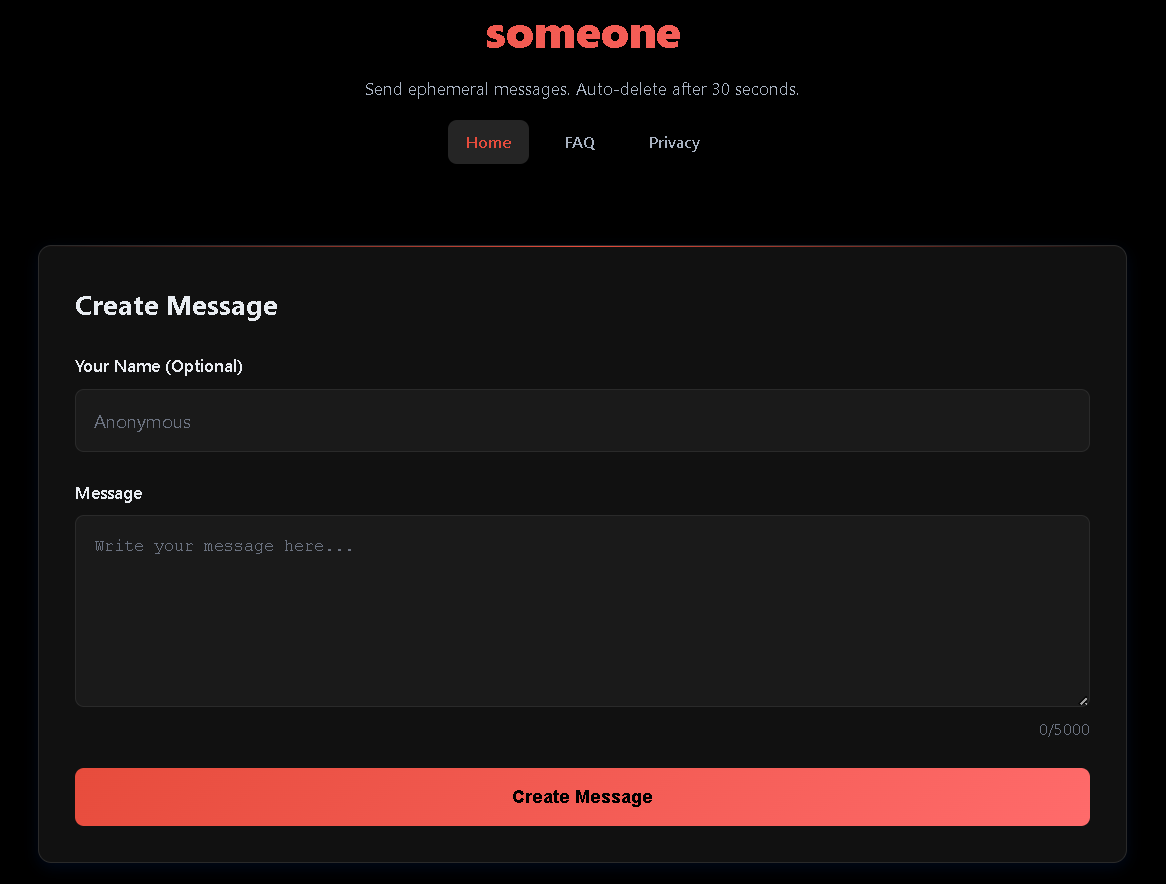
Core Features That Define Someone
30-Second Automatic Message Deletion
The centerpiece of Someone's design is the 30-second automatic deletion mechanism. After a recipient opens and reads a message, the system triggers automatic deletion from our servers within 30 seconds. This architectural approach ensures that sensitive information is removed from our infrastructure shortly after viewing. This deletion is permanent and cannot be recovered from Someone's systems. However, this does not prevent recipients from taking screenshots, exporting text, or capturing message content through other means before deletion occurs.
End-to-End Encryption (E2EE) by Default
Someone implements client-side AES-256-GCM end-to-end encryption as the default encryption model. Messages are encrypted on the client device before transmission to servers, and decryption keys are never stored on the platform infrastructure. This means Someone administrators have zero access to read end-to-end encrypted messages, even if they wanted to. The platform cannot be compelled to decrypt E2EE content because the encryption keys exist only on client devices. All communication between clients and servers is additionally protected via HTTPS/TLS. The security of this approach depends on proper key management, secure client-side implementation, and awareness that encryption keys transmitted via URL fragments require users to share links securely.
Zero-Knowledge Key Sharing
Someone uses secure key sharing via URL fragments (#key=...). Encryption keys are embedded in the message link and are never transmitted to the server. This means the server infrastructure has zero knowledge of decryption keys. When a recipient accesses a message, they receive the encrypted message payload and the decryption key from the URL, allowing client-side decryption. This architecture ensures that even Someone administrators cannot decrypt messages, providing true end-to-end encryption where the service provider cannot access message content.
Zero-Account Architecture
Unlike traditional messaging platforms, Someone requires zero account creation. Users don't provide email addresses, phone numbers, or usernames. This fundamental design decision eliminates:
- Account creation vulnerabilities
- Identity tracking and correlation
- Password management requirements
- Account verification procedures
Messages are created anonymously and shared via generated links. This is perfect for sensitive one-time exchanges without any user identification.
Advanced Bot and Crawler Prevention
A critical challenge in ephemeral messaging is preventing automated systems from inadvertently consuming messages before the intended recipient reads them. Social media platforms, messaging applications, search engines, and various monitoring tools automatically preview links to extract metadata and content. Someone's advanced detection system recognizes 25+ types of automated crawlers and bots, distinguishing between legitimate user access and automated systems. When automated access is detected, the system presents only generic security information, protecting the actual encrypted message for the intended human recipient.
Universal Compatibility
Someone works anywhere. No app installation required. The platform functions in all modern browsers (Chrome, Firefox, Safari, Edge) across all devices (desktop, tablet, mobile). This universal compatibility removes friction from the user experience and enables quick adoption.
Technical Architecture and Security Measures
Someone implements multiple security controls and best practices across its infrastructure:
- Client-side AES-256-GCM end-to-end encryption with keys never stored on servers
- Zero-knowledge architecture where encryption keys are shared via URL fragments (#key=...)
- Platform administrators have zero access to decrypt end-to-end encrypted messages
- Comprehensive security headers protecting against common web vulnerabilities
- Automated security monitoring and incident detection systems
- Production-safe logging systems that maintain operational visibility without logging sensitive message content
- Rate limiting and abuse protection to prevent denial of service attacks
- HTTPS/TLS encryption for all client-server communications
- Secure session management with CSRF (Cross-Site Request Forgery) protection
- Input validation and output encoding to prevent injection attacks
Like any security implementation, the actual security posture depends on correct deployment, ongoing maintenance, and proper client-side implementation. Security-conscious users should conduct their own security assessments if deploying Someone in critical environments. Users should also be aware that sharing links containing encryption keys via unsecured channels could compromise message confidentiality.
Addressing Privacy Concerns: What Someone Doesn't Track
In an environment where data collection has become the default, Someone takes a deliberately privacy-first approach. While the platform collects minimal analytics for service improvement, it categorically does not track:
- Message Content: Never logged or stored in plaintext
- Real IP Addresses: Only anonymized SHA-256 hashes stored temporarily
- User Accounts or Identification: Zero account infrastructure means nothing to identify
- Message Recipients: Who reads what remains unknown to the system
- Cross-Message Relationships: No ability to correlate messages from the same sender
- Personal Information: No email, phone, or personal data collection whatsoever
The minimal analytics Someone does collect (message creation counts, anonymous sender type, browser compatibility data) is automatically purged after 90 days. This approach balances operational necessity with privacy protection.
Real-World Use Cases
Someone's design is purpose-built for one-time, ephemeral message exchanges. Practical applications include:
For Professionals and Organizations:
- Temporary Credential Distribution: Share passwords, API keys, or access tokens with automatic deletion, reducing exposure window
- Confidential Communications: Exchange sensitive business information that should not create permanent records
- Contractor Access: Provide temporary access credentials that are automatically removed after communication
- Anonymous Reporting: Enable secure, one-time reporting of internal issues without account-based traceability
- Data Retention Compliance: Communicate sensitive information that automatically disappears, supporting regulatory compliance
For Personal Use:
- Secure Password Sharing: Share sensitive credentials with trusted contacts without persistent chat history
- Personal Confessions: Share private thoughts knowing they'll disappear permanently
- Sensitive Personal Information: Communicate SSNs, health information, or other sensitive data without permanent records
- One-Time Instructions: Share temporary directions, codes, or information that doesn't need permanent archival
For Developers and Technical Teams:
- Development Credentials: Share staging environment passwords or temporary keys
- Bug Reports with Sensitive Data: Share crash dumps or logs containing personal user information
- Security Incident Response: Communicate critical security issues without leaving permanent traces
- Third-Party Integration Secrets: Securely distribute API keys to contractors or partners
Someone's Security and Privacy Implementation
Someone is built from the ground up with privacy and security as first-class design principles. Here are the core capabilities that set Someone apart:
Client-Side E2EE by Default
AES-256-GCM end-to-end encryption on client devices. Encryption keys never stored on servers. Admins cannot decrypt E2EE messages. Keys shared securely via URL fragments with zero server knowledge.
Zero-Access Admin Model
Platform administrators cannot access, read, or decrypt end-to-end encrypted messages. No backdoors or admin decryption keys. Complete separation between infrastructure access and message content access.
Automated Bot Detection
Detects and prevents 25+ types of automated crawlers from consuming messages before intended recipients access them.
Multi-Layer Defense
CSRF protection, rate limiting, input validation, and secure file permissions provide defense against common attack vectors.
Privacy-Focused Design
No user accounts required. Messages are encrypted and deleted from servers after viewing. Minimal metadata collection compared to traditional platforms.
Automatic Message Cleanup
Messages are automatically deleted from servers 30 seconds after reading. Unread messages expire after 24 hours. Deletion is permanent from our infrastructure.
Security Monitoring
Comprehensive logging and analytics track security events to detect threats, without compromising individual user privacy.
Secure Admin Access
OAuth2 authentication with email validation ensures only authorized personnel can access platform administration functions.
Attack Prevention
Rate limiting and abuse detection prevent brute force attempts and denial of service attacks, ensuring reliable service for all users.
The Technical Challenge: Building True Ephemerality
Creating a system where data genuinely disappears requires solving several technical challenges that many assume are trivial but prove surprisingly complex:
Ensuring Permanent Deletion
Modern storage systems make permanent deletion deceptively difficult. Deleting a file doesn't immediately remove it from disk. The filesystem merely marks the space as available. Someone addresses this through encrypted storage and cryptographic key management, ensuring that even if disk sectors are examined, no plaintext message content remains recoverable.
Preventing Accidental Consumption
As mentioned, bot and crawler prevention is essential. Someone's intelligent detection system examines request patterns, headers, and behavioral characteristics to distinguish genuine human users from automated systems. When automated systems attempt access, the system responds with security notices while preserving the actual encrypted message.
Managing Unread Message Expiration
Someone automatically deletes unread messages after 24 hours, preventing indefinite storage of messages that recipients never retrieved. This clean garbage collection ensures that forgotten links don't perpetually consume storage resources.
The Journey to Production: Version 4.0.9
Someone has undergone significant evolution to reach its current production-ready state. Version 4.0.9 represents the latest milestone with major end-to-end encryption capabilities. Key milestones include:
- v4.0.1-4.0.5: Core functionality development and initial security implementation
- v4.0.6: Advanced bot detection system preventing unwanted message consumption
- v4.0.7: Security hardening and rate limiting improvements
- v4.0.8: Production-ready release with comprehensive security headers and monitoring
- v4.0.9 (Current): Major feature release introducing client-side AES-256-GCM end-to-end encryption by default with zero-access admin model and secure key sharing via URL fragments
Future Directions and Enterprise Considerations
While Someone is currently deployed on secure VPS infrastructure, enterprise customers with specific requirements can contact the development team to discuss custom solutions. The focus remains on maintaining the simplicity and security that define Someone while exploring ways to serve organizations with specialized needs.
Future developments may include open-source code availability for security audits, enhanced monitoring capabilities, and integration options for organizations seeking to implement ephemeral messaging in their workflows.
Conclusion: Privacy Through Design
Someone represents a different approach to ephemeral messaging. Rather than maintaining permanent message histories, Someone is purpose-built for one-time, secure exchanges. Messages are encrypted, shared via links, and automatically deleted from our servers after reading.
For professionals who need to share temporary credentials, organizations managing sensitive one-time communications, or individuals valuing reduced digital footprints, Someone provides a focused solution designed around automatic message deletion and minimal metadata collection.
However, it's important to understand the limitations: deletion from our servers does not prevent screenshots or external capture by recipients. Security depends on user awareness and careful deployment. For critical applications, conduct your own security assessment.
The philosophy behind Someone is simple: not all communications require persistent storage. Some should disappear by default. This design principle applies to credential sharing, temporary access, and sensitive one-time exchanges.